Are you a student or working professional looking for a simple way to take better notes?
Then you’re going to love the outline note-taking method. It’s an intuitive way to break down big ideas without creating those walls of text that we all hate.
To use the outline method, just put the main topic in the header, indent for subtopics or subpoints (and use bullet points), and indent again for more details (we’ll go into more detail below and give examples).
It organizes information hierarchically in a way that makes sense to your brain. It’s also super easy to do on a word processor, and it takes zero prep.
That’s why outlining is the most popular note-taking method for students and professionals.
In this guide, you’ll learn exactly how to use the outlining method, when it works best, and what to use instead when it doesn’t.
This is part of our full series on note-taking methods, where we break down the most popular note-taking formats so you can take better notes. You can automatically generate notes in all of these methods (and many more) with Plaud’s AI note-takers.
The Outline Note-Taking Method: Quick Overview
The outline method is a structured way to organize information by hierarchy.
In the outline note taking strategy, big ideas go first, and supporting ideas are indented underneath. When you’re done, your page mirrors the logic of the topic (and your brain feels happy). It’s one of the fastest and easiest ways to take notes on difficult subjects, because you don’t have to think too much about structure while you jot down notes.
Here’s how to do it:
-
Write the main topic at the top of the page.
-
Add major points underneath it.
-
Indent slightly for supporting details.
-
Indent again for examples, evidence, or explanations.
-
Keep everything brief. Don’t write long sentences.
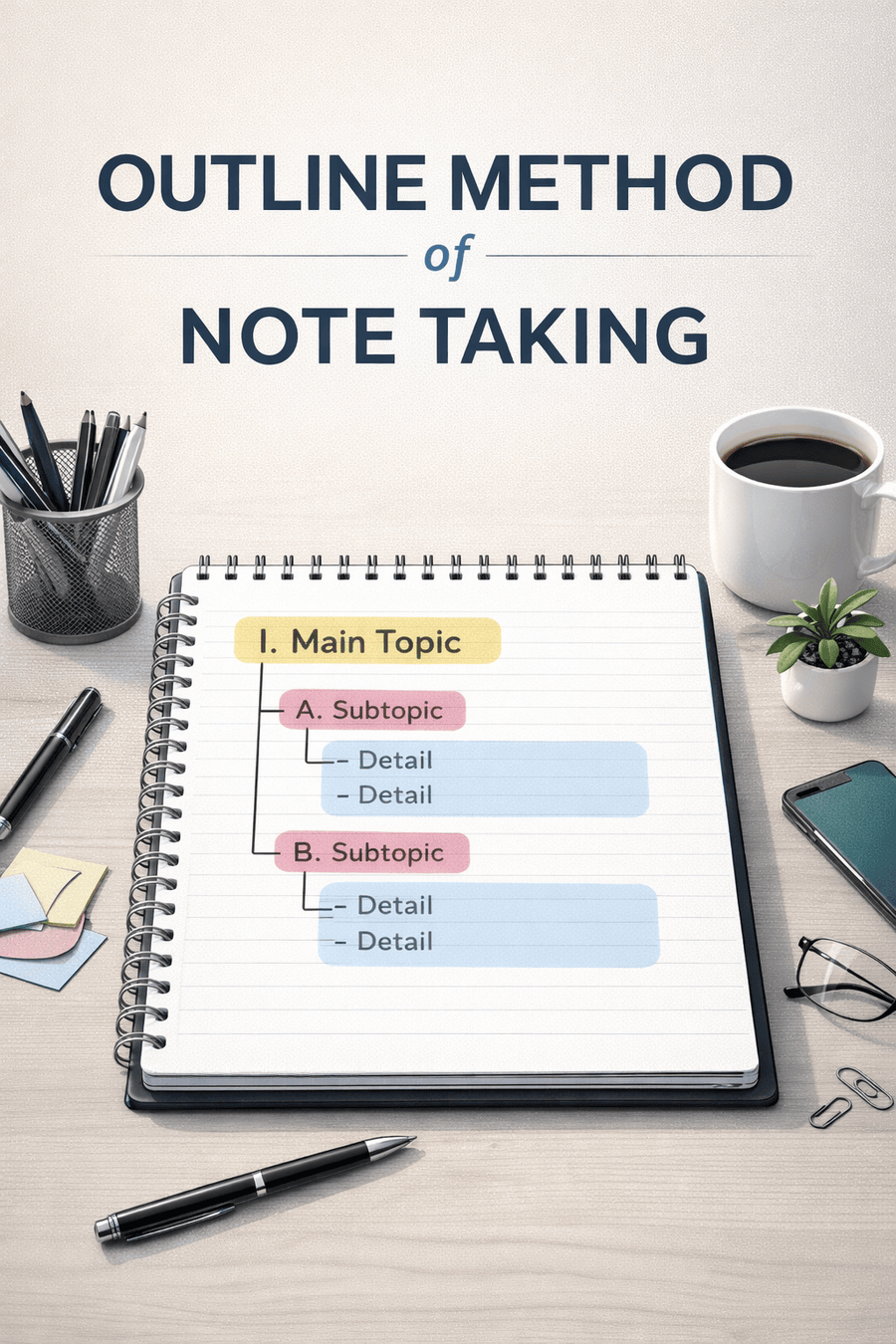
Here’s a quick example of what it looks like:

Outlining Method Pros
-
The outline format organizes ideas into a logical flow
-
Easy to review before exams or meetings (especially when you use color coding)
-
Forces you to identify main points
-
Works well for lectures and structured meetings
Outlining Method Cons
-
Not ideal for visual subjects like math or design
-
Can feel rigid during fast brainstorming
-
Harder to use if the speaker jumps around
Alternatives to the Outlining Method
-
Cornell Method for built-in review and summary
-
Quadrant Method for meetings
-
Flow Method for creative work and brainstorming
-
Focused Notes for deeper retention
What is the Outline Method of Note-Taking?
The outline method is a hierarchical format for organizing information. It categorizes information in a simple hierarchical structure so you can understand how topics relate to one another.
Here’s how it works on the page:
The main topic sits at the top, and supporting facts go underneath. Further details are indented below those, and you can go on and on this way to go into as much depth as you need (we don’t recommend more than 3 indents, though).
When you’re done, your notes are organized into digestible pieces that reflect the structure of the topic. The reason students love it is that it helps with memory retention, saves time, and is the most visually appealing of all the methods.
So, why does it work so well?
The outline method works well because it mimics how we transfer information (as well as receive it). Here are a few examples:
-
Professors lecture by starting with big ideas and breaking them down into more complex information.
-
Managers run meetings by starting with key topics and moving to goals, problems, assignments, etc.
-
Textbooks are written with chapters followed by subsections and supporting facts.
The outline note-taking method mirrors our natural information delivery logic on paper (or screen).
Further Reading: Still writing meeting notes by hand? Check out our guide on how to automate meeting notes and saves hours of time each week.
Who Should Use the Outline Method
This method works especially well for students and professionals who want to organize factual information logically. It works well when:
-
You’re attending lectures with clear sections
-
You’re summarizing nonfiction books
-
You’re preparing for exams
-
You’re sitting in structured meetings with agendas
-
You’re planning essays, reports, or presentations
But it’s not always the best method for taking notes. It’s not great for visual note-taking that involves diagrams. It doesn’t work well for unstructured lectures or notes, either (such as brainstorming). The flow method is much better for that.
Note: If you're a student and still writing notes by hand, we highly suggest that you get with the times. We highly recommend that you get an AI note-taker made for recording lectures. You'll save time, save effort, and get more accurate notes, without trying to listen and take notes at the same time.
How to do the Outline Method Step-by-Step
The outline note-taking method might look simple… and that’s because it is.
But it does take a little bit of practice and discipline. If you just indent randomly, your notes can get very confusing. The goal is to build a clear information hierarchy.
Follow this systematic approach to outlining, and you’ll be taking beautiful notes in no time.
1. Start With the Main Topic
Write the main subject clearly at the top of the page. This should be the central theme of the entire meeting or lecture (like the chapter title in a book).

2. Chunk Sections Based on Major Points
Under the main topic, add the biggest supporting ideas first. These are like information categories, not details.

You’ll often hear signal phrases like:
-
“There are three main causes…”
-
“Let’s move to the next section…”
-
“First… second… third…”
These are your cues to start new sections.
3. Indent for Supporting Details
Now we add depth. Under each major point, indent slightly and list supporting ideas.

These could be:
-
Examples
-
Evidence
-
Definitions
-
Statistics
- Key names or dates
Then, indent again if you need to clarify further.
4. Use Visual Signals
Use color, symbols, and other visual tricks to draw your attention to key points.

Here are some examples:
-
Circle key terms
-
Underline definitions
-
Add symbols like “→” for cause and effect
-
Use stars for “likely exam question” or “action item”
Just don’t overdo it. Too many visual signals will clutter your notes.
5. Review and Refine
After the lecture or meeting, take five minutes to clean up your notes. You might realize that some main topics should actually be subtopics. Or, you might want to fill in some more details that you think are important to the overall flow.
This doesn’t usually take long, especially while it’s still fresh in your mind. As a bonus, it also massively boosts retention to do this step right after you take notes.
6. Adapt the Structure to Your Learning Style
Not every topic fits perfectly into clean bullets and indentations. If you find a note-taking hack that works for you, incorporate it into your outlines.

You might want to:
-
Create small diagrams
-
Add mnemonic devices to the left margin
-
Highlight important points (like dates) for easier review
Outline Method Example
Want to see what the outline method of note-taking looks like in practice? Here’s a real-world example of a full outline note-taking flow.

Notice how the structure is rigid (the format stays the same), but there’s still lots of room for adjustments and personal touches?
What Are the Advantages And Disadvantages of the Outline Method?
If you’re not sure whether the outline note-taking method is right for you, take a quick look below at its main advantages and disadvantages based on some important note-taking criteria. You’ll also find our top alternatives to the outlining method for each use case (we’ll go into more details on those later, too).
|
Criteria |
Advantages (Why it works) |
Disadvantages (Where it fails) |
The Better Alternative |
|
Organization |
Visualizes a logical flow (it shows a clear hierarchy from big to small). |
May be too rigid. Can fail if the speaker jumps back and forth between topics. |
The Boxing Method (Keep topics in separate boxes regardless of order). |
|
Reviewing |
Highly skimmable. |
Can become a "wall of text" that feels overwhelming to read later. |
The Cornell Method (Use the left margin for "Cues" to break up the text). |
|
Speed |
Minimal writing. It uses bullets instead of full, clunky sentences. |
Requires high mental effort to "categorize" info in real-time. |
The Flow Method (Write freely and use arrows to connect ideas as they come). |
|
Visuals |
Clean and professional layout looks great for handwritten or digital notes |
Terrible for subjects requiring diagrams, charts, or math. |
Mind Mapping (Draw branches to visualize connections and add sketches). |
|
Retention |
Forces you to identify the main ideas while you are listening. |
You can end up "transcribing" without actually understanding the info. |
The Q/A Method (Write your notes as Questions and Answers instead of points). |
Plaud.AI’s Outline Method Note Template
What if you could create perfect outline notes without having to write (or type) anything? Believe it or not, Plaud can do exactly that. Our AI note-taker records meetings and lectures and turns them into structured notes afterward. It’s quite literally the future of digital note-taking in action.
Plaud can create notes in any method, including the outline method. If you have an outline style you like, just snap a photo of it and show it to Plaud AI. Then, Plaud will automatically generate notes exactly how you want them.
Take a photo of this outline method note template and upload it to the Plaud app. Plaud will take it from there.

Alternatives to the Outline Method
The outline method is structured and logical, but it’s not perfect for every situation.
Some speakers and lecturers don’t deliver information in a clear and structured manner, which can make it hard to categorize your notes.
And for some people, the outline method just doesn’t fit their learning style, either. In that case, it’s best to try another method.
Here are a few good alternatives to try:
-
The Cornell note-taking method: This method involves dividing your page into sections for cues, notes, and summary. It takes more prep than the outline method, but it’s great for taking notes that you need to review later. If you’re a student, you’ll love it for exam prep.
-
The quadrant method: This method is made for meetings. It splits the page into four sections, each with its own category (tasks, ideas, questions, follow-ups, etc.). It’s cleaner than burying action items in paragraphs, but it does require you to have some idea of what a meeting is about beforehand.
-
The flow method: Also known as mind mapping, this is a good choice for creative or fast discussions. You write ideas in a more freeform way and connect them visually with lines or arrows. It’s less rigid but can also get messy if there are a lot of things to write down.
-
Focused notes (AKA the AVID method): This note-taking style was designed to maximize memory retention. It’s one of the best note-taking strategies for studying a new topic. It involves revisiting your notes later and rewriting them more clearly, forcing deeper understanding.
-
The sentence method: The sentence method is one of the most straightforward ways to take notes. And it’s great for meetings, lecture content, capturing important ideas, or even business meetings. Every new piece of information gets written as its own numbered sentence, line by line, in the order it comes at you. It works best in fast-paced lectures or meetings where information moves quickly and you don't have time to organize on the fly. The downside is that reviewing these notes later can feel messy, since nothing is grouped or prioritized. But for visual learners who like pure speed and simplicity, it's hard to beat.
-
The charting method: The charting method is a highly structured style of note-taking that organizes information into rows and columns. It’s like a spreadsheet, but handwritten. You set up categories across the top and fill in details as they come. Analytical thinkers love it. It's a solid pick for content that repeats patterns, like science, law, or finance. Comparing ideas side by side becomes effortless. The downside? It needs setup before you start, so it's not great for unpredictable conversations. But when the material fits, reviewing your notes later takes half the time.
Final Thoughts
The outline method is great for basic note taking, but we highly recommend you upgrade to an AI note-taker. You'll get 98% accurate notes automatically. All you do is record, choose a template, upload audio, and that's it. If you're not sure, check out our article on the best AI note-takers. We fully realize that Plaud is not the only note-taker out there. Read up and find the best for your situation.