AI summary
- AI medical scribes use NLP to listen during patient encounters and automatically produce structured clinical notes (SOAP, BIRP, DAP), reducing documentation time and physician burnout.
- Clinicians should evaluate solutions based on capture method (app-based, meeting bot, dedicated device, or wearable), EHR integration depth (Epic, Cerner, athenahealth), HIPAA compliance and BAA availability, and total cost of ownership.
- Different workflows require different tools — software scribes (Freed, Nabla, Suki, DAX, DeepScribe, Abridge) are the default starting point: no hardware cost, immediate setup, strongest EHR integration; hardware scribes (Plaud Note, Plaud NotePin) solve the specific problems that arise when the physician is moving between patients, both hands are occupied, or the phone is unavailable as a recording device.
The best AI notetaker for doctors in 2026 isn't just about AI quality — every leading tool has strong transcription. The decision comes down to what type of device you're using to capture audio, because that determines what your workflow actually looks like across a clinical day. AI medical scribes split into two fundamental types: software and hardware. Each has two sub-categories, and choosing the wrong one means friction that no AI model can fix.
Part 1: Software AI scribes
Software scribes run on existing devices — your phone, computer, or both. No shipping, no charging a second device, immediate setup. This category contains the majority of AI medical scribe products on the market today.
A. App-based AI scribes
App-based scribes — Freed AI, Nabla, Suki AI, DeepScribe, Abridge — are software tools that run on mobile apps, web browsers, or desktop interfaces, and use the microphone of whichever device you're on to record and transcribe clinical encounters. They generate structured clinical notes (SOAP, BIRP, DAP, and specialty variants) using the conversation as input.
How they work in practice: In clinical settings, most physicians use these tools on their smartphone — placing the phone on a surface in the exam room, opening the app, and pressing record. Some tools (notably Suki and DAX) also offer desktop or EHR-embedded modes. After the encounter, the AI generates a note you review before pushing to your EHR — either via copy-paste or, for tools with native integration, directly into chart fields.
Strengths:
- No hardware to buy, charge, or carry
- Strong SOAP and specialty note quality across leading tools
- Free tiers available (Nabla offers a no-cost entry plan; Freed has a free trial period)
- Improving EHR integrations — Abridge is listed in Epic's App Orchard; Suki integrates with Epic, Cerner, and Oracle
Real limitations when used on mobile in clinical settings:
- An incoming call stops the recording — if a nurse calls mid-consultation, the session ends
- Switching to another app (EHR lookup, drug reference, calculator) stops the recording
- The phone must be placed on a surface during the encounter — creating a visible device between physician and patient
- All recording hours compete with your phone's battery; a 12-patient day can drain a phone to under 20%
Note: These limitations apply specifically to mobile use. When used via desktop or EHR-embedded mode (available in tools like Suki and DAX), some of these constraints do not apply — but desktop use is not practical for physicians moving between exam rooms.
For a single telehealth session at a desk, none of these are problems. For a high-volume in-person clinic, they compound across every patient.
B. Meeting bot AI scribes
Meeting bot scribes — Otter.ai and Fireflies.ai — work by joining a video call as a virtual participant. They capture both audio streams from the call and generate a transcript and summary.
How they work in practice: You schedule a call, the bot joins automatically or via an invite link, and a note is ready when the call ends. For telehealth practices running scheduled video appointments, the workflow is clean.
Strengths:
- Purpose-built for telehealth — captures both sides of the video call cleanly
- Low cost (Otter.ai starts at $10–$17/month)
- No additional device or microphone setup required
Real limitations:
- Cannot capture in-person encounters — using a meeting bot for a face-to-face patient visit requires opening a video call in a physical room, which defeats the purpose
- Hospital and clinic IT departments increasingly block third-party bots from accessing Epic and Cerner telehealth sessions on security policy grounds — this is an active operational issue, not a theoretical risk
- Do not work in low-bandwidth or offline environments
Part 2: Hardware AI scribes
Hardware scribes are dedicated physical devices — separate from your phone — with their own microphone, battery, and local storage. They operate independently regardless of what your phone is doing, who is calling, or whether Wi-Fi is available.
This category currently has two meaningful sub-types: dedicated device recorders and wearable recorders.
A. Dedicated device AI scribes
A dedicated hardware AI scribe is a standalone recorder that you carry or place in the room, separate from your phone. It captures audio independently with a professional-grade microphone, stores recordings locally, and syncs to the AI platform when connected.
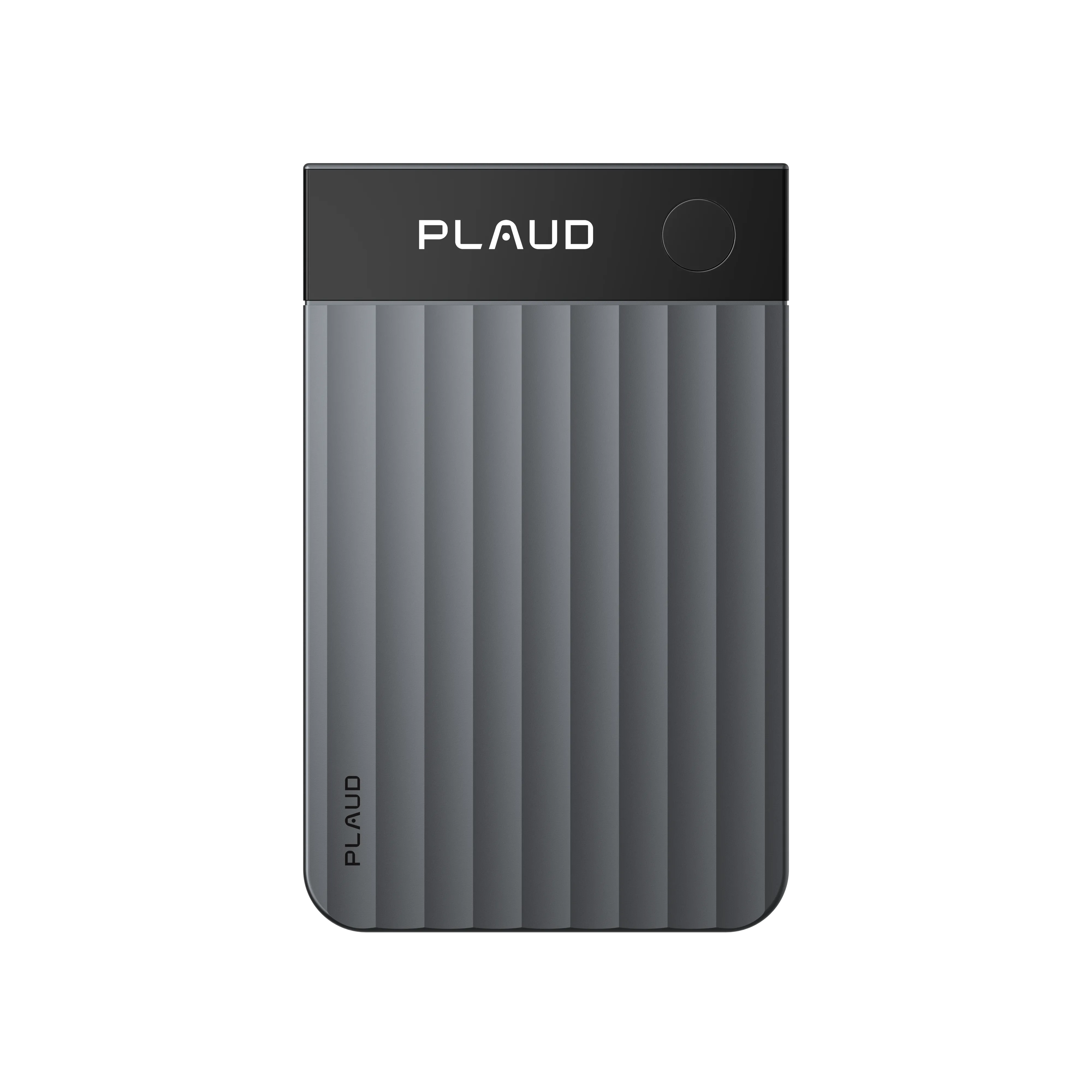
Plaud Note is the primary product in this sub-category: a slim card-shaped device (0.12 inches thin, 1.06 oz) with 30 hours of continuous recording, 64GB of local storage, and a key differentiator from wearable hardware — dual-mode recording. Plaud Note magnetically attaches to the back of your phone and uses a built-in vibration conduction sensor to capture both sides of a phone call. This matters for physicians who document patient callbacks, specialist coordination, or referral calls in addition to in-person encounters.

Strengths:
- 30-hour battery — covers the full clinical shift without recharging
- Phone call recording — captures patient phone callbacks and coordination calls that app-based scribes cannot
- Offline recording to 64GB local storage — no Wi-Fi dependency
- Not affected by your phone's incoming calls, app switches, or battery state
Real limitations:
- Requires carrying and placing a second physical device
- No native EHR integration — notes export via app and templates rather than direct API push
B. Wearable AI scribes
Wearable AI scribes take the dedicated hardware concept further: the device is designed to be worn on the body throughout the clinical shift. There is no surface to place it on, no positioning between patients, and no setup per room. It is on the physician's body from the start of the shift to the end.
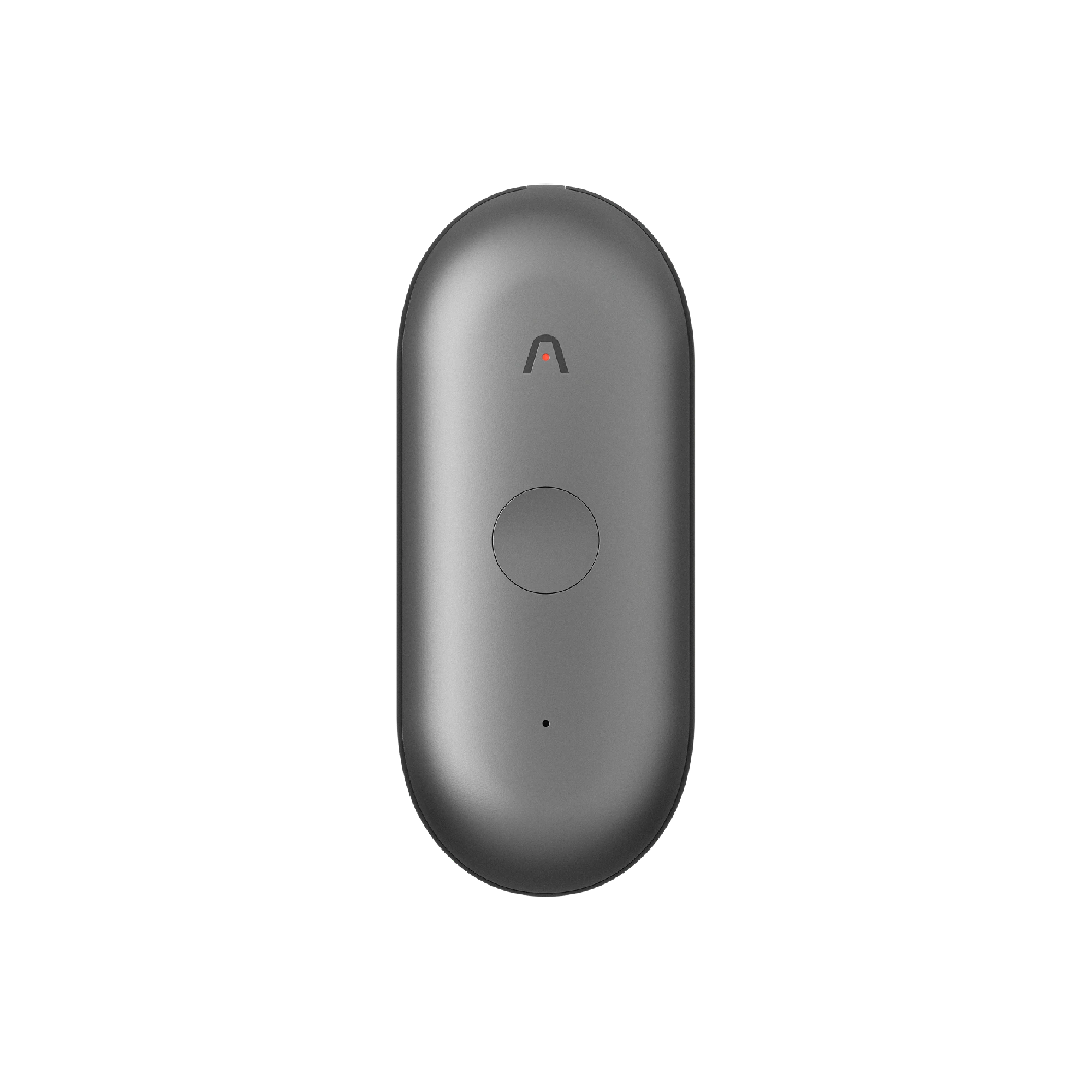
Plaud NotePin is the defining product in this sub-category. At 0.59 oz (lighter than an AA battery), it clips to a white coat lapel, wristband, or lanyard via a magnetic pin or clip. One press begins recording. It captures audio up to 9.84 feet away with 2 MEMS microphones, runs for 20 continuous hours on its own 270mAh battery, stores up to 64GB of local storage offline, and transcribes in 112 languages with a built-in medical industry glossary that prioritizes clinical terminology accuracy.

Key distinction from Plaud Note: NotePin does not include a vibration conduction sensor, so it does not support phone call recording. It is purpose-built for in-person encounters.
Strengths:
- Worn on the body — no per-room setup, no surface required, hands completely free during physical exams
- 20-hour battery independent of your phone — zero impact on phone battery state
- Medical glossary built into the transcription engine — handles clinical phonetics (drug names, anatomical terms, ICD-adjacent vocabulary) that generic speech recognition mishandles
- Offline to 64GB — reliable in basement exam rooms, rural clinics, mobile care settings
- Apple Find My is compatible — locatable if misplaced
- HIPAA, SOC 2 Type II, ISO 27001, ISO 27701, GDPR, EN 18031 certified; BAA available
Real limitations:
- Does not record phone calls
- No native EHR integration — same export-based workflow as Plaud Note
- 20-hour battery (vs. 30 hours for Plaud Note) — sufficient for full shifts, but shorter than the dedicated device
Full comparison: All four sub-types
| Items | App-Based Scribe | Meeting Bot Scribe | Dedicated Hardware (Plaud Note) | Wearable Hardware (Plaud NotePin) |
|---|---|---|---|---|
| In-person encounters | Yes (phone on table) | No | Yes | Yes |
| Telehealth / video calls | Yes | Yes | Via Desktop app | Via Desktop app |
| Phone call recording | No | No | Yes | No |
| Hands-free during exam | No | No | No | Yes |
| Worn on the body | No | No | No | Yes |
| Recording stops on incoming call | Yes | No | No | No |
| Phone battery impact | High | High | Zero | Zero |
| Blocked by hospital IT | No | Frequently | No | No |
| Battery life (own device) | Phone battery | N/A | 30 hours | 20 hours |
| Offline recording | Limited | No | Yes (64GB) | Yes (64GB) |
| Medical glossary | Varies | No | Yes | Yes |
| Clinical templates | 10–100 | Limited | 10,000+ | 10,000+ |
| EHR integration | Varies (some native) | Varies | Export-based | Export-based |
| HIPAA | Yes (major healthcare tools) | Enterprise only (Otter.ai) | Yes | Yes |
| Hardware cost | $0 | $0 | $159 | $159 |
| Monthly subscription | Free–$250 | $10–$40 | From $17.99 | From $17.99 |
Where software AI scribes are the right choice
Telehealth-first or video-only practices
If the majority of patient encounters happen over video, software scribes — particularly Freed, Nabla, or DAX — integrate naturally without requiring any additional device. The workflow is already screen-based; a software scribe fits without friction.
Health systems require native bidirectional EHR integration
Three enterprise software tools lead here, each with a different model: Nuance DAX Copilot uses ambient listening to auto-generate and push notes into Epic, Cerner, or Oracle with zero physician interaction during the encounter. Suki lets physicians use voice commands to update specific EHR fields in real time. Abridge is purpose-built for academic medical centers and is listed in Epic's App Orchard for institutional deployment. No hardware product currently matches this depth of EHR integration.
Athenahealth users
DeepScribe has specialty-trained models and native athenahealth integration specifically. If your practice runs on athenahealth, it is the strongest integration option available.
Budget-constrained or early-stage testing
Nabla offers a free tier to test AI note quality before committing to a paid plan. Freed's $99/month is a reasonable entry point for solo practitioners who want strong AI without hardware commitment.
A note on HIPAA and BAA for software scribes
All major app-based scribes purpose-built for healthcare — Freed, Nabla, Suki, DeepScribe, and Abridge — offer Business Associate Agreements (BAA) for healthcare providers, which is a requirement under HIPAA for any vendor that handles protected health information (PHI) on your behalf. Otter.ai achieved HIPAA compliance in July 2025 and will sign a BAA — but only for Enterprise plan customers. The standard consumer plans ($10–$17/month) do not include BAA and cannot be used for PHI under HIPAA. For clinical documentation, Otter.ai is only suitable at the Enterprise tier.
Where hardware AI scribes are the right choice
In-person rounds across multiple rooms
Each app-based scribe session used on a phone requires unlocking the phone, opening the app, and positioning it on a surface — roughly 3 deliberate steps per room. Across 15 patients, that is 60 steps that do not exist with a device worn on the body or placed once at the start of a shift.
Physical examinations require both hands
Auscultation, palpation, wound care, and neurological assessment — the physician's hands are occupied. A wearable device on the lapel records without requiring any surface. An app-based tool used on a phone requires a surface and a specific placement to capture usable audio.
Practices where phone call documentation matters
Software scribes cannot capture regular phone calls. Plaud Note's dual-mode recording captures both sides of a patient callback or specialist coordination call via magnetic attachment — a use case with no software equivalent at this price point.

Long shifts in offline or low-connectivity environments
Both Plaud Note and NotePin record to local storage regardless of network availability. Basement exam rooms, rural clinics, and mobile care settings where Wi-Fi is unreliable are not problems for hardware.
Practices with IT-restricted environments
Meeting bots are frequently blocked by hospital security policies. App-based software scribes are unaffected. Hardware devices are unaffected.
Which AI notetaker is best for doctors?
Best for solo practitioners
Freed AI — $99/month, no device required, consistently rated highest for SOAP note readability among individual physicians, immediate setup with no IT involvement.
Best for large health systems requiring ambient AI and EHR auto-documentation
Nuance DAX Copilot — ambient listening mode requires no physician interaction during the encounter; notes are generated and pushed directly into Epic, Cerner, or Oracle chart fields. The right choice when zero post-encounter manual steps is the priority.
Best for physicians who want voice command control over EHR fields
Suki AI — rather than passively listening and generating notes, Suki lets physicians speak commands to update specific EHR fields in real time (e.g., "add diagnosis hypertension," "order CBC"). Integrates with Epic, Cerner, and Oracle. Best fit for physicians who want active voice-driven documentation rather than ambient auto-generation.
Best for academic medical centers
Abridge — listed in Epic's App Orchard, purpose-built for academic hospital environments with research and teaching workflow requirements. The strongest option for health systems that are already deep in the Epic ecosystem and need institutional-grade deployment support.
Best for in-person clinical practice (rounds, exams, therapy, home visits)
Plaud NotePin — 0.59 oz worn on the body, both hands free during physical exams, 20-hour battery independent of the physician's phone, 9.84-foot capture range, built-in medical glossary. The right choice for any setting where a physician is moving between patients or cannot place a phone on a surface.
Best for physicians who also document patient phone calls
Plaud Note — dual-mode recording captures in-person encounters and both sides of phone calls via vibration conduction sensor, 30-hour battery. $159 device, with plans starting at $17.99/month.
Best for telehealth-only workflows
Freed AI or Nabla — no hardware needed, strong video transcription, Nabla's free tier allows testing before financial commitment.
Best for Athenahealth users
DeepScribe — native athenahealth integration with specialty-trained models, the strongest option for practices built on that EHR.
Summary
- Software scribes (app-based) are the default starting point for most physicians — no hardware cost, immediate setup, strong AI output. Best fit for telehealth workflows, solo practitioners (Freed AI), and health systems requiring native EHR integration (DAX Copilot for Epic/Cerner auto-documentation, Suki for voice command EHR control, Abridge for academic medical centers, DeepScribe for athenahealth).
- Meeting bots (Otter.ai, Fireflies) work for scheduled telehealth video calls but cannot capture in-person encounters and are frequently blocked by hospital IT. HIPAA compliance requires Otter.ai's Enterprise plan; standard plans are not suitable for PHI.
- Hardware scribes solve problems that software on a phone cannot — recording stops on incoming calls, phone battery drains, and both hands cannot be free simultaneously. Plaud Note adds dual-mode recording for phone calls; Plaud NotePin eliminates per-room setup entirely as a wearable device.
- No single tool is best for every workflow. The right choice depends on whether encounters are in-person or remote, whether EHR integration is required, and whether the physician's phone is available and reliable as a recording device throughout the shift.